

"If I could go back in time, I would tell myself: 'You will love your daughter, you will manage in high-tech, and you will know it’s okay to say no.'"
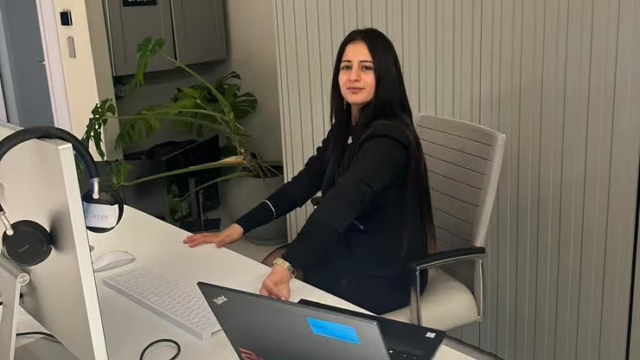
At 20 years old, Tzipora Mordechai found herself raising a baby she hadn't wanted, all alone. She was struggling with undiagnosed depression, with no money and no job.
"I looked at the baby and told my sister: 'Take her away from me,'" she recalls.
Today, at 23, she is a manager at a high-tech company and teaches students through "Last Chance" programs. The journey from rock bottom to success happened through the organization ELEM, where for the first time, she saw herself not just as a "failed mother," as she used to say, but as the strong woman who has been there within her since childhood.
Written by Avivit Mishmari
Ynet
September 12, 2025
"I remember looking at her—it was the day after the birth—she was crying so much, and all I wanted to do in those moments was take the pillow behind me and stop those screams. I said to myself, you're f***ing 20! Why do you need to raise a tiny, demanding creature now?
I wasn't ready yet to be a mother. I felt like it was too much for me and that I wasn't able to cope with it. I had looked forward to the birth very much, I imagined that moment as romantic and magical, but in reality, there was nothing romantic or magical about it. It was a moment where I realized that my life was changing from one extreme to the other, and that I wasn't at all sure that this was what I wanted to happen right now.
I always saw mothers hugging their child and loving them, but after the birth, I looked at my baby and told my sister, "Take her away from here. I don't want her, don't put this disgusting thing on me!" Even during the hospitalization, any time I could put her in the nursery, I brought her there. And during the hours when I was forced to feed her, I suffered every moment."
Tzipora Mordechai, age 23, grew up in a Haredi (Ultra-Orthodox) family. When she was 12, her parents divorced, and from there, her rapid downward spiral began. "I started working nights as a waitress. I would earn a hundred shekels an event, and with that money, I tried to help my mother. Because I was so tired, I almost never went to school. At the same time, I started hanging out on the streets a lot. I met boys, discovered drugs, alcohol, and everything that comes with that."
At age 15, she was kicked out of school. "I remember that meeting at the Yeshiva. The principal looked at me and said: 'Tzipora, I just want to tell you before you leave—know that nothing will ever come of you.' I left there feeling terrible, and I began looking for a place to live that would suit my needs."
After a long search that yielded nothing, and just a moment before she was about to give up, in the middle of 11th grade, she finally felt she had found the right place for her: the "Branco Weiss" school in Bat Yam—or as she calls it, "The Last Chance."
"It's not a school that is offered to everyone," she says. "Only boys and girls who are considered 'problematic' study there—those who didn't fit into any other educational framework. This is their last chance before they are moved to closed institutions that don't resemble a school in any way."
For Tzipora, who hadn't truly been part of an educational framework since 9th grade, entering the new school felt like a free-dive into deep water. To her surprise, instead of sinking into the abyss, she blossomed there. She managed to complete her studies with a full matriculation certificate (Bagrut). "I even signed up for academic reserve studies in Communications," she says with pride.
But then, just a few weeks before she turned 20, while she was still in the middle of her academic reserve studies, she became pregnant from a partner she knew from the neighborhood.
"I didn't want this pregnancy. It didn't feel right to me at that stage," she says with honesty. "But he really wanted to keep it. I went along with him, convincing myself that I couldn't really oppose him—that this child was his, too, and that I didn't have the right to terminate if he wanted to keep it."
The unexpected pregnancy led the two to the Chuppah (marriage altar). A few months later, shortly before her 20th birthday and just as she was finishing her academic reserve studies, Tzipora gave birth to their daughter. "The birth happened during my studies, but I didn't give up," she says. "I kept going until the end and came out with a Communications Engineering certificate."
"I was very, very proud of myself then," she adds. "And the truth is that even today I'm proud that I managed to finish despite it not being easy at all, and there were very difficult moments in the middle."
But the harsh reality was not long in coming. When the baby was two months old, Tzipora and her partner separated, and she was left alone with a small baby and a postpartum depression that would only be discovered later. "He was the sole breadwinner of the house. He was everything. And after the separation, I found myself alone—without a job, without money, and without help. I felt the ground collapsing beneath my feet. I remember asking myself what I even have in life worth continuing for."
With no other choice, Tzipora moved in with her mother-in-law. "I didn't have a good relationship with my family at all, and my mother didn't have a large enough house either. We are five siblings, and all of them except for me were living in that same house at the time. The last thing they needed was me and my daughter with them," she explains. "My mother-in-law's house was the only place where I could live for free, because I had no money at all at that stage."
However, living with her mother-in-law did not bring the longed-for relief. "She criticized me incessantly, especially regarding my mothering. She would say I was a bad mother and wouldn't stop asking why I didn't relate to my child."
She stops for a moment, choosing her words carefully. "Deep inside, I knew her criticism was right. I truly didn't love the child that was born to me, and I didn't care if she cried until tomorrow; it just didn't interest me."
And yet, this criticism was painful.
"Very much so," she says. "After all, there is a difference between feeling that you don't love your daughter and hearing it all the time without any filter, and in the most hurtful way possible. It weakened me, caused me to cry a lot, and primarily damaged the little confidence I had left in myself and in my mothering."
Tzipora found herself in an impossible situation: a young mother with undiagnosed depression, without money, without family support, and with no idea how to get out of the emotional pit she had been forced into.
After several difficult weeks of trying to cope with everything falling on her, she realized she needed professional help. "The only person I thought could help me was the alumni coordinator at the 'Branco Weiss' high school where I studied. I reached out to him, and he connected me to the Young Mothers at Risk program of the organization ELEM."
I stop for a moment, and for the first time since the start of the interview, a genuine smile appears on my face. "I have butterflies in my stomach when I talk about my connection with the organization," she says. It’s truly an endless love story. Even today, the connection with this program hasn't ended. They are amazing."
She remembers the first meeting with the program mentors as a breakthrough.
"I felt that, finally, there was someone who saw me—my needs, my difficulties. They saw Tzipora, not just the 'non-functioning mother' of her baby, like everyone else around me did."
The mentors helped her understand that her inability to bond with her daughter was the result of postpartum depression, not a lack of love or a personal failure. This diagnosis was the key to her recovery, as she finally understood that she needed professional treatment to change her situation.
Tzipora is one of over 80 young women who receive support within the framework of the national project for young mothers in situations of risk by ELEM, which was established four years ago. Most of the young women in the project come from difficult backgrounds—childhood trauma, growing up in families that didn't function due to violence, neglect, and poverty. They became mothers in the hope of creating a stable, warm family for themselves and their children, but the difficult reality and lack of support from family, the community, and the state leave them in a state of poverty, loneliness, and despair.
In Israel, when a young woman at risk becomes a mother, her social rights are stripped from her until then, and the focus passes solely to the best interests of the child. They are pushed to the fringes of society along with the child and do not receive even the few rights they are entitled to. As a result, they remain in a difficult survival situation and lose faith in themselves and their ability to acquire basic skills as a condition for integration into employment.
The mentor process is two years long and begins with creating a bond of trust between the young woman and the mentor; a staff member or a trained volunteer. Together, they build a work plan with goals and objectives, and start exhausting rights, finding childcare settings, and professional and employment guidance. "But the support is also emotional," adds Keren [a project coordinator]. "The young women open up, receive help, and feel they have a strong and stable support system, sometimes the only one in their lives."
In Tzipora's case, the mentors in the program were the first to identify that no one else around her understood that it was a matter of depression and not a "bad mother" or "laziness," as her relatives used to tell her. "They helped me understand that I don't 'just not love her' like I thought until then, but that I am suffering from postpartum depression that doesn't allow me to connect to her," she says. "And as a result, it was also very hard for me to care for her. Then I understood that without professional help and treatment, nothing would change."
The final identification process happened at Tipat Halav during routine visits with the baby. "I was terrified to go there, I felt like they were trying to trip me up. Every time I would come, the nurses would ask me in an accusing tone: 'why is her shirt dirty?" or 'why hasn't she bathed?' And what could I say to them, that I don't care about her?'"
But even without her saying a word, the nurses understood. "They identified that there was a problem, and they diagnosed me as suffering from severe postpartum depression," she says. To this day, she remembers the terrible feeling of those visits. "During that time I was crying almost 24/7. I would look at the nurses with a look of 'what do you want from me? Check the girl, give me what is needed and let me go from here!' I always left there with a feeling that they wanted to take her from me."
The breaking point came when Tzipora started talking with her mother-in-law about putting the girl up for adoption. "I will never forget the moment when I felt that I was no longer able to contain this reality, that even one more day was too much for my soul," she recalls in pain. "On that day, I went to my mother-in-law and told her, 'I am no longer capable. I want them to take her from me.'"
"When I shared this with my mentor from ELEM, she looked at me and said, 'Tzipora, no. I’m coming with you tomorrow to Tipat Halav!' And indeed, from the moment she joined me for the visit, they looked at me differently. I won't forget how she scolded one of the nurses who checked my daughter and asked her, 'why are you talking to her so aggressively? Especially when you know she is dealing with depression? You need to contain her and not the opposite.'"
Beyond the practical help with the baby, the mentorship provided something more profound: a recovery process based primarily on professional therapy and conversations with the staff.
"Until then, I felt like nothing, that my desires and opinions didn't matter. After all, I hadn't chosen to get pregnant or give birth at such a young age, and I certainly hadn't chosen to turn into a single parent and live in my mother-in-law's house," she describes with painful honesty.
"For the first time in my life, I met women who saw me beyond the story of my life and put me at the center. They would ask me,'Tzipora, what do you want? What would be good for you? What do you feel and what do you need?' Slowly, I began to believe in myself again and learned how to regain control over my life, and eventually, these were the things that healed me and brought me back to functioning".
As part of her recovery, ELEM helped her navigate the complex bureaucracy of the National Insurance Institute. She was able to claim rights she didn't even know she had, receiving a monthly stipend for the first time in her life. The organization also helped her realize her professional worth, which allowed her to find a job suitable for young mothers.
"Thanks to them, I was able to handle debts of over 100,000 Shekels that had accumulated over the years. Much of who I am today is thanks to ELEM".
The third year of the program brought an extraordinary opportunity. Every year, ELEM submits a "Youth Situation Report" to the President of Israel. Instead of just reading about the girls' successes, the organization decided to have a ceremony at the President's House where the girls could tell their own stories of success.
At that event, representatives from high-tech partners like Nvidia, Amdocs, and Bank Hapoalim were in attendance. These partnerships were essential to the project's ability to offer professional horizons to its graduates.
Nvidia, which has adopted the southern center of the program for Young Mothers at Risk for four years, helps measure impact. Data shows that over 90% of the young women who start the program eventually graduate to an independent path.
Tzipora recounts the moment her dream became a reality at the President's House.
"I arrived at the President's House to tell my story, and just before I finished, I mentioned that my biggest dream was to work in high-tech. Right then, Harel Geva, who was the CEO of Amdocs Israel at the time, approached me and said. 'I want you to work for us.'"
Tzipora was in total shock, asking, "Really?" What started as a promise at a public event turned into a year-long process of interviews across various departments.
"I didn't believe it was really happening. The whole time I was afraid it was just a dream, and that when I woke up, I would return to being that confused Tzipora without a direction."
A year later, she met Shahar Shmuel, her current manager, for a final interview. When he looked her in the eyes and said "you're accepted," she was so certain she had misheard him that she asked "What?" He repeated it, and the moment she left the room, she burst into tears of joy.
Two years after that interview, Tzipora has been promoted and is now a Lead in a major department at the company. In her spare time, she also teaches and mentors at-risk youth.
"I am a communications coordinator in Raanana for students who were exactly like me, just a moment before falling, who were sent to the 'Last Chance' school."
Sharon Dayan, VP of Human Resources at Nvidia, concludes:
"Tzipora is an example of how even from the depths of the abyss, rejection, and disconnection, it is possible to grow and rehabilitate. Success stories like these reinforce our understanding that we are succeeding in creating real impact—in the community, in the employment market, and in the personal lives of the women we accompany. This is our moral duty."
"Today I wake up in the morning and smile because I know that an interesting day is about to begin where I feel useful and am fulfilling dreams," says Tzipora. "When I return home after a day of work, I have something to tell my daughter, and she knows her mother has a job she loves and is appreciated in".
When asked what she shares with her daughter, she says, "I tell her about the people I met that day, about the suppliers at my work, even about the food I ate at lunch. She really enjoys hearing it".
These days, Tzipora lives with her daughter in supportive housing provided by the "Or Shalom" association in Bat Yam, as part of a project called "HaDerech" (The Way). This project is designed for single mothers and young women living in a shared building.
"The friendships created between us are healing. We have become a small female community that shares a lot in common. Each of us lives with her children in a separate apartment, but we spend a lot of time together; cooking, doing activities together, and spending many hours with one another, as do our children".
The unique housing system also provides a daycare solution for her daughter and therapeutic accompaniment.
"We receive amazing dyadic treatment [parent-child therapy]. I can really see the improvement since we started. My daughter was very closed off, and since the treatment began, she has opened up a lot. Like a flower that was invested in and nurtured, she began to bloom."
After years of total disconnection, Tzipora’s relationship with her family has improved dramatically.
"Today, because I am better within myself, it makes me more pleasant and better toward others. The disconnect with my family wasn't just because of me, but I played a part in it too. For a long time, I was very depressed and I pushed them away; I wasn't pleasant and I didn't participate when they tried to reach out to me, and no one wants to be around a person who behaves that way."
"Today, when I am good and happy, we go for Shabbat at my mother's sometimes, and we talk on the phone a lot," she describes with a smile. "My mother even takes my daughter out occasionally. From my perspective, that is a massive achievement. And my daughter loves her, and that is what's most important and makes me happy."
"The fear that maybe I’m not a good mother is always there. With children, there are all kinds of complex situations where I’m not sure how to respond, and sometimes I feel my heart rate rise and anxiety take over my thoughts, driving me crazy with questions like, 'wait, did I react correctly just now, or did I make a mistake?'"
The situation with her daughter’s father is more complex. Their relationship is currently inconsistent, and he only asks about the child occasionally. Tzipora notes:
"It is important to me that she knows she has a father and doesn't grow up feeling like he doesn't exist, even though the situation is obviously not ideal for her."
Tzipora admits that fears from her past still surface, specifically the worry that she isn't a "good enough" mother. In moments of parenting complexity, she sometimes feels a rising heart rate and intrusive anxiety, questioning if she reacted correctly or made a mistake.
However, she highlights the difference between her life then and now.
"Today, she feels comfortable consulting with her close environment. Through the project, I always have a mentor I can turn to when things go south. And I never forget what they taught me at ELEM—I'm allowed to be nervous or sad sometimes. It’s okay to be a human being."
She concludes with a powerful realization.
"When I think about where I was then and where I am today, I realize that if I managed to get through that desperate period—everything else is small by comparison. What could possibly be worse?" she laughs.
"I am completely in love with my daughter now," she answers with a wide smile spreading across her face. "I want her to know that because of her, I am here; that because of her, I became a better person. I feel a sense of mission and fulfillment because of her, because I have someone to give to. I have someone to provide for and I take care of my girl exactly the way I wanted someone to take care of me when I was a child. I am not selfish, despite everything I’ve been through. It’s amazing."