

"There is a feeling of betrayal that the State did not keep its promises"
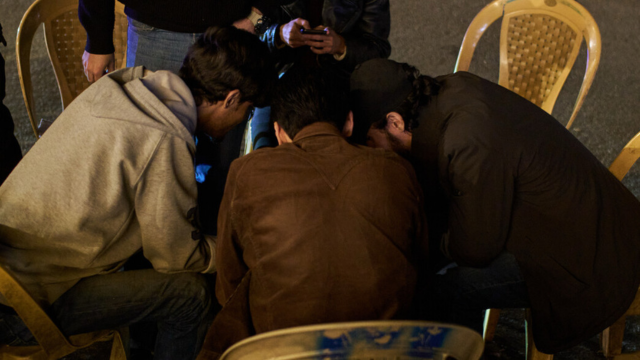
"In Tzfat and Kiryat Shmona, teenagers wander the streets despite having no warning time, dismissing the sirens and speaking of emotional numbness. A new report by ELEM reveals a sharp rise in anxiety, anger, and self-harm among teenagers during Operation Roaring Lion. 'Ever since a missile fell on my house, I’ve had panic attacks every now and then,' says a 13-year-old."
Written by Shiri Shain
Mako
April 19, 2026
S., a 13-year-old from the North, was sitting in a hotel for evacuees while the missiles were still falling. He spoke about the moment a missile hit his home, the friends who remained in the city without him, and the panic attacks that have accompanied him ever since. "What helps me overcome it is the ocean," he said. "I go to see the ocean every now and then."
G., a 14-and-a-half-year-old from Tel Aviv, described an opposite process. "At first, I was really stressed. Now, I’ve relatively gotten used to it," says G. "When there’s an alarm and I’m in the safe room, I try not to get stressed and play with whoever is there."
Both of them, each in their own way, represent a generation forced to grow up under fire and develop survival strategies that no child should have to know.
New data from ELEM paints a troubling picture. The report, based on 91 assessments from field workers at 30 programs across the country, points to a significant deterioration in the mental state of teenagers during Operation Roaring Lion compared to 2025's Operation Am-Kalavi:
-
30% increase in anxiety
-
73% increase in anger
-
21% increase in substance use
-
70% increase in self-harm
Yet beyond the data, field reports reveal a more complex reality. About half of the field workers at ELEM report boredom and a distinct lack of activity among the youth, which creates a chain of deterioration: from detachment to apathy, loneliness, and then reckless behaviors. The youth are not just experiencing distress; they are worn down to the point of dangerous apathy. As the guidelines become stricter, more and more of them choose to remain outside, film interceptions, or simply ignore the alarms.
Rami (a pseudonym), a 12th grade student from Holon, describes this emotional numbing.
"During [Operation] Am-Kalavi, I was more anxious. When there was an impact in Bat Yam, I heard the shaking. I will never forget it," he recounts. "In this war, at the beginning, we went to the shelter. After a few days, we started to dismiss. Sometimes it comes down, sometimes not. I got fed up. What bothers me more than the missiles are the gaps that have accumulated in my exams. I have a huge gap in my matriculation exams, and I don't know how I will overcome it," he says.
Tali Erez, the CEO of ELEM, identifies a fundamental difference between the two operations.
"There is something very prominent between Am-Kalavi and Roaring Lion," she says. "A feeling of betrayal that the State and the adults did not fulfill their promises, that it would pass, that it would be a temporary filter, that they would return home. Especially in the North, there is a large population that did not return, and those who did return think they will have a support system."
Erez describes a particularly difficult reality in the northern settlements.
"They have remained the human shield of the State of Israel," she says. "In the most dangerous places, in Tzfat and Kiryat Shmona, we see youth wandering around even though they have no warning time. Whoever could flee fled. A population remained that stayed for idealistic reasons or out of a lack of choice, and that is where we see the anger."
Erez speaks about a generation that is in one war too many.
"We understand that this is no longer a one-time event but a continuous reality," she says. "With Am-Kalavi, it was a 12-day campaign. Today, we are looking at a campaign of over six weeks, and in the North, it is not yet over."
She describes two extremes that the youth find themselves caught between.
"Either apathy and great emotional numbness, where they think 'I am not stressed, and my life is not worth much,' and 'I don't rush to the shelter because that is my survival mechanism,' or that the numbness leads to the use of alcohol and drugs or self-harm, in order to feel that something is happening."
What worries her especially are the long-term consequences.
"There is no country in the world, except for Ukraine, where teenagers have experienced so much uncertainty since the October 7," she says. "From one upheaval to another. It worries me what will happen next, what kind of soldiers they will be, what kind of students, what kind of partners and parents. We have a responsibility for an entire generation."
Erez calls on the education system to change.
"Education systems need to look at the children as a whole, and not just at the grades," she says. "On Wednesday, they announced that studies are returning to normal. You cannot go from 0 to 100."
In the field, ELEM is working together with the Ministry of Welfare and National Insurance to build a national plan.
"We need to create a routine within the chaos," Erez says. "To create mechanisms that will allow the youth to meet, hear a familiar voice, have a regular adult present, make home visits, and show them that they haven't all been abandoned. These children haven't had school for six weeks. Their routine has been taken away."
She also addresses the parents.
"Just as we still go to the grocery store, it must be clear that teenagers need structure; at least one family meal a day, limiting screen time, establishing a morning wake-up routine, and not turning day into night," she says. "And for the local authorities, youth movements and the authorities can create vitality. In the first two weeks, they used Zoom. Now there needs to be meetings in the shelters."
Ultimately, Erez circles back to the core of the issue.
"A teenager who is in front of a screen all day feels alone in the world. A sense of low self-worth and a fear of communicating can develop," she says. "The most significant challenge is to create a sense of certainty within a reality that they can cope with. A child goes to sleep at night and doesn't know if they will wake up to an alarm. It is important to provide the feeling that things will be okay."