

"We are asking teenagers to return to the classroom – while their heads are still in the bomb shelter"
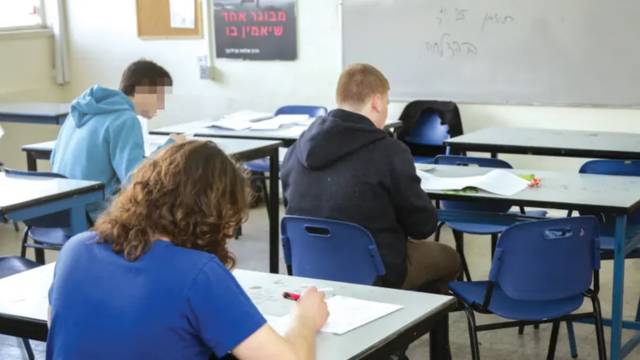
"When it comes to youth, you can't simply erase six weeks of sirens and sleepless nights. We must not neglect the emotional state of our children."
Written by Tali Erez
Maariv
April 13, 2026
In the coming days, the education system will return to operating as usual. On the surface, a return to routine is welcome. In practice, for many teenagers, there is no routine to return to. Six weeks of war, sirens, sleepless nights, staying in protected spaces, and constant worry for family members and friends in combat — these are not things that can be "switched off" to simply move on.
They join a much longer, continuous stretch of instability for this generation: COVID-19, social isolation, and now repeated security rounds. For these youth, this is not just a "period." It is a continuous reality.
Rehabilitation cannot only be about the central hubs of the country. Real rehabilitation is measured by the ability to restore those outlying communities where routine still hasn't returned. The data points to a consistent picture: boredom, loneliness, and anxiety are not marginal phenomena but a starting point for many teenagers. From this place, feelings of detachment, indifference, and anger develop, and sometimes reckless behaviors. This isn't out of defiance but an attempt to create a sense of control or belonging in a reality that has lost its predictability and familiarity.
Not everyone is returning to that routine. While the center of the country speaks of returning to studies and activities, for youth in the North, the war has not ended. Their routine is disrupted, and the sense of danger is present. When a teenager in the North looks at the public discourse, he often feels that the improvement felt in the center does not reflect his reality, making that reality seem even more dire.
One of the most significant insights during this period is that risk is no longer concentrated at the margins. It is no longer the sole domain of "at-risk youth" in the narrow and familiar sense. It crosses homes, neighborhoods, and sectors. In this sense, there is almost no home in Israel that hasn't been touched by risk, sometimes visible and sometimes hidden.
Against this backdrop, another danger arises: the automatic return to routine. Systems tend to restore themselves quickly, returning to schedules, curricula, and old metrics. But when the return is done without taking into account the emotional and mental state of the youth, it doesn't create stability. Rather, it deepens the gap.
The challenge for the educational staff and the adults in these teenagers' lives is to be a "significant presence." It is not about having all the answers or being able to promise that "everything will be okay" but about the ability to see the teenager, listen to what isn't being said, and allow for the processing of experiences.
In these days, we must prefer connection over the curriculum. If we don't lay the emotional foundation today, we will find ourselves with a "lost generation" whose scars will surface in much more difficult ways in the future. We must understand that the classroom is not just a place for learning. It is a space for protection, belonging, and healing.
Ultimately, the resilience of Israeli society will not be measured by the grades on matriculation exams (Bagrut) but by our ability to wrap our youth in a supportive and present envelope. We are asking them to return to the classroom, but we must be there to meet them with a heart that is open and attentive to everything they have gone through and are still going through.